The UAE has over 200 nationalities eating under one flag, and the food culture shows it. You’ll find dishes here that have been perfected over centuries sitting next to restaurants that opened last Tuesday. But eating habits in the UAE go far beyond what’s on the plate. They’re woven into the rhythm of daily life – how you greet someone, how you close a business deal, how you spend your Fridays. Whether you’ve just landed in Dubai or you’ve been here long enough to have a favourite karak chai guy, this guide covers the full picture: the food, the rituals, and the unwritten rules that every resident eventually learns.
Traditional Emirati Dishes Every Resident Should Try
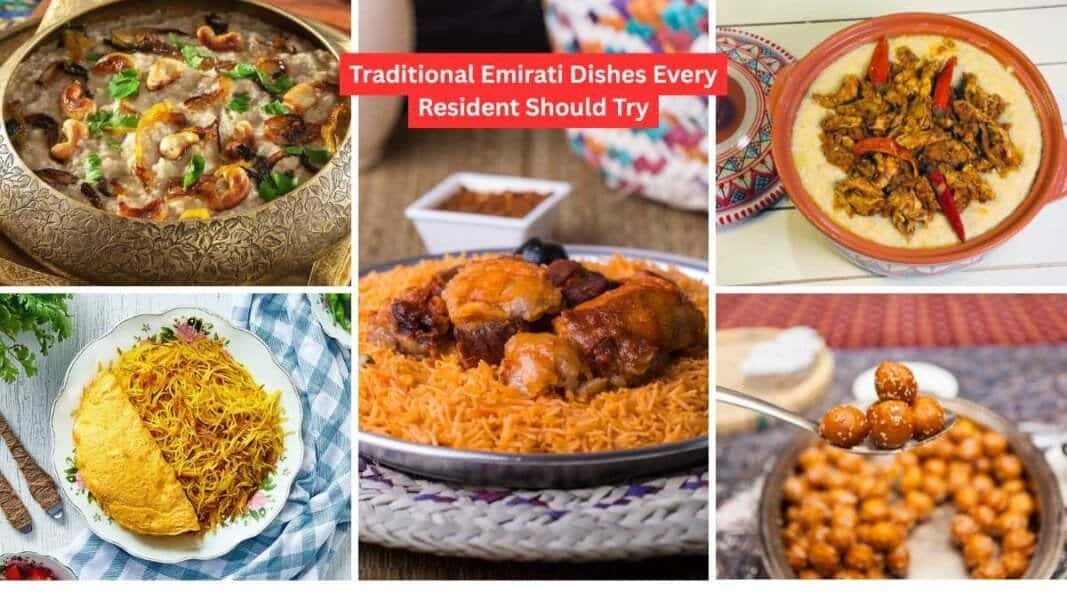
Emirati cuisine is built on bold spices, slow-cooked meats and grains that sustained Bedouin communities for generations. If you’ve been in the UAE for more than a month and haven’t tried these, you’re leaving a gap in your local education.
Machboos
The national dish of the UAE. Fragrant basmati or broken rice cooked with meat (usually lamb or chicken), cardamom, cinnamon, and those distinctive dried limes (loomi) that give it an almost citrus undertone. It’s comfort food that’s utterly addictive once you understand the layering of flavours. For the best versions in Dubai, head to Al Fanar at Dubai Festival City or Al Seef – their machboos has been consistently excellent since 2011, and the Al Seef branch earned a Michelin Guide selection. Gerbou in Nad Al Sheba does a refined take that elevates the dish with farm-to-table ingredients and underground pit cooking.
Harees
A rustic dish of crushed wheat cooked slowly with meat until it reaches a creamy, porridge-like consistency. You’ll see this everywhere during Ramadan and at weddings – it requires serious patience to prepare, which is why it’s reserved for special occasions. Al Fanar’s version stays true to the traditional method, and during iftar season you’ll find it on nearly every hotel buffet spread in the city. the fuss.
Balaleet
Sweet vermicelli noodles topped with a savoury omelette and date syrup. It sounds odd on paper, but it’s a beloved breakfast that’s been feeding families here for centuries. Sweet, savoury, soft, crispy – it’s a textural masterclass. The Arabian Tea House in Al Fahidi serves one of the best versions in Dubai at AED 25 (about USD 7), in a courtyard setting that feels like stepping back into old Dubai. Logma at Dubai Mall does a contemporary take that’s become popular with younger crowds.ries.
Luqaimat
Golden, deep-fried dough balls the size of walnuts, served with warm date syrup. These are serious business during Ramadan and at celebrations. One is never enough, and you’ll find yourself reaching for another as soon as you finish the first. Arabian Tea House and Logma both do excellent versions – the trick is eating them while they’re still warm.
Jareesh
Cracked wheat cooked to a creamy consistency with meat, onions, and ghee. It’s another staple that’s especially popular for breakfast or light dinners. The wheat gives it a nutty, wholesome quality that’s become quite fashionable again. Gerbou’s version, seasoned with their signature smoky flavour from the outdoor pit, turns this humble dish into something worth a special trip to Nad Al Sheba. Several five-star hotels in Dubai now serve their own refined versions at weekend brunches.
Wow-Emirates Expert Tip: For a proper introduction to Emirati cuisine, start at Al Fanar Al Seef for the full traditional experience, then graduate to Gerbou for the elevated version. Arabian Tea House in Al Fahidi is perfect for breakfast dishes like balaleet and chebab in a setting that captures old Dubai beautifully.
The Arabic Coffee Ritual
Arabic coffee – gahwa – was inscribed on UNESCO’s Representative List of Intangible Cultural Heritage in 2015. This isn’t just a drink. It’s a codified social protocol.
Gahwa is made from lightly roasted beans, cardamom, cloves and sometimes saffron. The result is aromatic, slightly bitter and served in tiny handleless cups filled only a quarter of the way. The etiquette is specific: accept with your right hand. When you’ve had enough, shake the cup gently side to side. If you want more, simply hand it back without shaking. Most guests have between one and three cups.
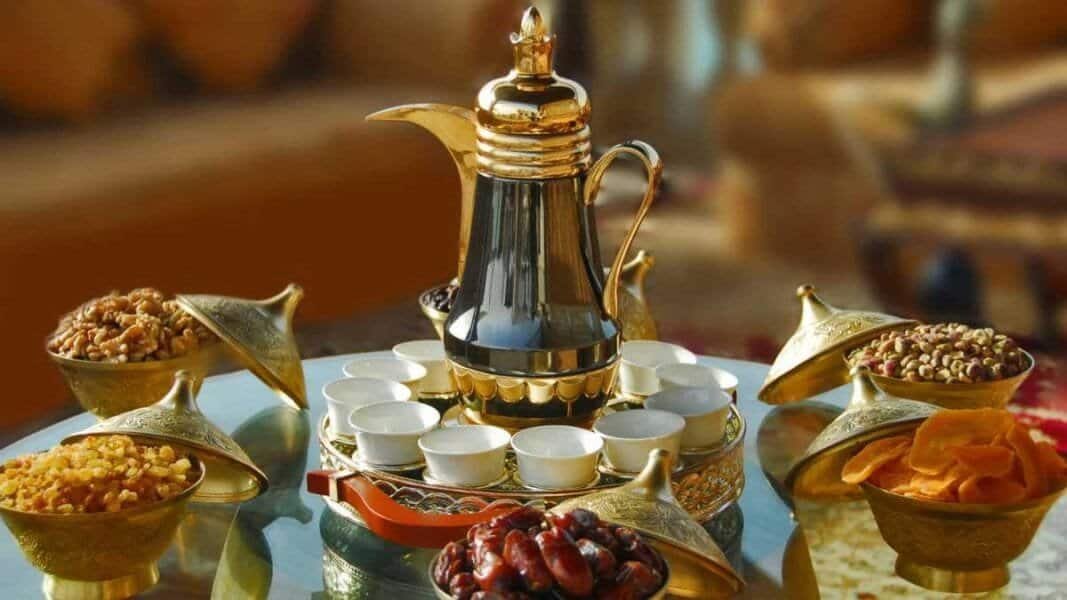
It’s always served with dates. The slight bitterness of the coffee balanced by the sweetness of the dates creates a pairing that’s been appreciated here for centuries. You’ll encounter this in homes, offices, government buildings and traditional majlis settings throughout the Emirates.
Wow-Emirates Expert Tip: If you’re invited to a business meeting or a formal gathering, accepting gahwa when offered isn’t optional – it’s how you signal respect for the host’s hospitality. Refusing can genuinely offend.
The coffee is brewed in a dallah – a traditional long-spouted brass pot with a distinctive pear shape. Watching someone brew gahwa in a traditional setting is one of those quiet cultural experiences that stays with you.
Traditional Beverages Worth Knowing
Beyond coffee, the UAE has drinks that have sustained desert communities for centuries and still show up everywhere today.
- Karak tea is the unofficial drink of Dubai. Introduced with the Indian diaspora in the 1960s, it’s black tea boiled with cardamom and ginger, mixed with condensed and evaporated milk. Strong, sweet and available at virtually every corner for AED 1-3 (USD 0.25-0.80). From construction sites to office towers to the queue at Dubai’s best happy hours – karak is the universal equaliser.
- Laban is a fermented yogurt drink that’s cooling and slightly tangy – popular year-round but especially beloved in the summer months. Some versions are salted, some served with cucumber and herbs. Every family and restaurant has their own take.
- Jallab is a purple-hued drink made from grape molasses, dates and rose water, topped with pine nuts and raisins. Particularly popular during Ramadan, the sweet, slightly floral taste triggers genuine nostalgia among long-term residents.
How Ramadan Reshapes Daily Life
Ramadan fundamentally transforms eating habits across the entire country. This is the ninth month of the Islamic lunar calendar, when Muslims fast from sunrise to sunset – no food, no drink, not even water.
Two meals define the month. Suhoor is the pre-dawn meal eaten before fasting begins, typically between 3 and 5 am. Iftar is the evening meal when the fast breaks at sunset, usually around 6 to 7 pm. These aren’t casual snacks – they’re substantial meals that sustain people through 14+ hours without food or water in summer months.
During daylight hours, eating, drinking and smoking in public spaces is strongly discouraged out of respect for those fasting. Since the 2021 federal decree, it’s no longer a criminal offence, but the cultural expectation remains firm: if you’re not fasting, eat and drink discreetly, indoors, out of sight. Most restaurants that serve non-fasting customers do so behind screens or in designated areas. Businesses typically operate on shortened schedules – often 6 hours instead of the standard 8 or more.
Iftar is where things come alive. Neighbourhoods set up communal iftar tents. The Emirates Red Crescent organises large-scale community meals. Families gather around tables laden with dates, soups, bread and mains. Hotels across Dubai host elaborate iftar buffets that have become events in their own right – some of the most popular require booking weeks in advance. The rhythm of Ramadan is slower, more intentional and deeply rooted in community.
Wow-Emirates Expert Tip: If you’re new to the UAE, attend at least one communal iftar. Many mosques and community centres welcome non-Muslims. It’s one of the most genuine cultural experiences available to expats – and the food is outstanding.
The Friday Brunch – Dubai’s Signature Ritual
If Ramadan is a spiritual reset, Friday brunch is Dubai’s answer to the pressure of a 50-hour work week. It’s the ritual that defines the weekend for hundreds of thousands of residents.
The format: an all-you-can-eat-and-drink spread at a five-star hotel, typically from 12:30 pm to 4:30 pm. Seafood stations, carving stations, sushi bars, dessert tables and bars serving champagne and cocktails – all for one fixed price. Budget-friendly options start at AED 200 (USD 55) with soft drinks. Mid-range hotel brunches run AED 300-500 (USD 82-136) with house beverages. Premium experiences at properties like Atlantis or Waldorf Astoria hit AED 600-900+ (USD 163-245+) with premium pours.
But here’s what makes it uniquely Dubai: it’s not really about the food. Friday brunch is the social pressure valve. Friends decompress after brutal work weeks. Families spend unstructured time together. Colleagues bond outside the office. You’ll see groups camped at the same table for four hours, slowly working through courses, talking, laughing, and building the relationships that actually make expat life work.
Saturday brunches are gaining ground as weekend structures shift, but Friday remains the standard. If you’re mapping out options, our complete Dubai brunch guide covers 80+ venues ranked by vibe, budget and occasion – and for the specifically boozy end of the spectrum, the best boozy brunches guide has you covered.
Dubai’s Street Food Scene
Some of the best food in Dubai costs less than a coffee at a hotel lobby. The streets of Karama, Satwa and Bur Dubai – neighbourhoods where working and middle-class families have lived for decades – are where authenticity lives.
- Al Mallah in Karama has been serving 24-hour shawarma since the 1980s. The meat is perfectly spiced, the bread is warm and fresh, and the prices are almost laughably cheap at AED 10-15 (USD 3-4). Late-night workers, students and expats queue at all hours. One shawarma here is a rite of passage.
- Ravi Restaurant in Satwa earned its reputation the hard way – decades of consistently brilliant Pakistani food. The butter naan is exceptional, the nihari (slow-cooked meat stew) is deeply comforting, and the whole experience captures something essential about Dubai: multicultural, unpretentious and real. A full meal runs AED 25-40 (USD 7-11).
- Bu Qtair near the creek has been serving fish for generations. Plastic stools, no frills, just incredibly fresh seafood cooked simply. The grilled hammour (grouper) for AED 30-50 (USD 8-14) is superb. Locals still queue here, and the experience feels genuinely timeless.
These aren’t tourist traps. These are where Dubaiites actually eat – less photogenic than the mall restaurants, infinitely more authentic.
For a broader look at what makes Dubai’s food scene tick beyond street food, check out the 10 best Dubai foods everyone should try
Food Delivery Apps That Run the City
The modern eating habit in Dubai is increasingly app-driven. A typical week for most residents involves ordering through at least two of these platforms.
- Talabat dominates with roughly 76% of UAE order volume and access to over 20,000 restaurants. It started as a local GCC player and now handles everything from street food to fine dining. This is the app most residents open first.
- Deliveroo positions as the premium option, focusing on quality restaurants and operating a dark kitchen model – restaurants that exist purely for delivery. If you’re ordering upmarket, Deliveroo is usually the pick.
- Careem Food built traction through electric delivery bikes introduced in 2024, appealing to environmentally conscious residents. It’s become a strong player for last-mile delivery in dense urban areas like Marina and Downtown.
- Noon Food is the growing challenger backed by Saudi Arabia’s PIF, gaining ground through competitive pricing and aggressive restaurant partnerships.
| App | Market Position | Best For | Delivery Fee | Restaurant Count |
|---|---|---|---|---|
| Talabat | Market leader (~76% order volume) | Everything – widest range from street food to fine dining | AED 5-10 (USD 1.50-3) | 20,000+ |
| Deliveroo | Premium positioning | Quality restaurants and dark kitchen exclusives | AED 7-15 (USD 2-4) | 3,000+ |
| Careem Food | Growing challenger | Dense urban areas (Marina, Downtown) – electric bike delivery | AED 5-12 (USD 1.50-3.50) | 2,000+ |
| Noon Food | Emerging competitor | Competitive pricing and subscription deals | AED 5-10 (USD 1.50-3) | 1,500+ |
If you’d rather have the restaurant come to you, the best dining deals in Dubai are worth bookmarking alongside your delivery apps
Dates – The Cultural Anchor
Dates deserve their own section because they’re not just food here – they’re a symbol of heritage, survival and hospitality that runs through every layer of Emirati life.
Historically, dates were the lifeline for Bedouin communities. A handful of dates and water could sustain a day of desert travel. That practical importance became cultural weight. Today, when food options are infinite, dates remain fundamental to identity.
They’re served fresh, dried, stuffed with nuts, coated in chocolate or made into paste. The varieties are vast: Medjool dates are large and meaty, Deglet Noor are delicate, Barhi are creamy when fresh. Connoisseurs can spend hours on the differences – and premium date boxes from Saudi Arabia or North Africa are the standard business gift. This isn’t accidental. A box of dates says: I value this relationship.
During Ramadan, the first thing eaten after the fast breaks is always a date. This comes directly from Islamic practice. One date, eaten slowly, followed by water – then the iftar meal begins. The rule is universal and never broken.
Dining Etiquette Every Expat Should Know
Understanding eating habits in the UAE isn’t complete without the unwritten rules. These matter more than most expats realise.
- Right hand for everything. Eating, greeting, passing food – always the right hand. The left is traditionally considered unclean. Even if you’re left-handed, make the effort. Locals notice and appreciate the respect.
- Shoes off at the door. If invited to an Emirati home, remove shoes at the entrance unless told otherwise. Non-negotiable in traditional households.
- Accept the gahwa. When offered Arabic coffee or dates, accept graciously. Refusing can be read as rejecting hospitality itself. If you genuinely can’t eat or drink, a polite “Thank you, I’ve already eaten” works.
- Dress modestly in traditional settings. Cover shoulders and knees at family gatherings or majlis events. This shows respect and makes hosts comfortable.
- Phone off the table. Especially in formal or traditional settings. Conversation is valued in Arab culture, and a phone on the table signals disconnection from the people present. For more on navigating Dubai’s social and dining landscape as a newcomer, our guide to business lunches in Dubai covers the professional dining etiquette side.
Frequently Asked Questions
Machboos – fragrant rice cooked with meat and warming spices like cardamom, cinnamon and dried limes. You’ll find variations across the Emirates, but the core concept is consistent. It’s available at local restaurants in Satwa and Bur Dubai from AED 25-45 (USD 7-12) and at hotel restaurants for AED 80+ (USD 22+).
Traditional dinner runs late – typically 8 to 10 pm, especially during cooler months. Younger residents and professionals often eat earlier (7 to 8 pm) due to work schedules. During Ramadan, iftar at sunset (around 6 to 7 pm depending on the month) replaces the standard dinner time entirely.
In formal or traditional settings, yes. Refusing gahwa when offered is read as rejecting hospitality. In modern business or casual settings, a polite “No thank you” is acceptable – the key is declining graciously, not abruptly.
Since the 2021 federal decree, it’s no longer a criminal offence. However, eating, drinking or smoking in public spaces during fasting hours is still strongly discouraged and considered disrespectful. Most restaurants serve non-fasting customers behind screens or in designated areas. The expectation for non-fasting residents is simple: eat discreetly, indoors, out of sight.
An all-you-can-eat-and-drink buffet held at five-star hotels, typically from 12:30 pm to 4:30 pm. Prices range from AED 200 (USD 55) for soft drinks packages to AED 900+ (USD 245+) for premium experiences with champagne. It’s the signature Dubai weekend ritual – less about the food, more about the social decompression after a long work week.
Karama, Satwa and Bur Dubai. Al Mallah for shawarma (24 hours, AED 10-15), Ravi for Pakistani food (AED 25-40) and Bu Qtair for seafood (AED 30-50). These neighbourhoods have served working and middle-class families for decades, so the food stays authentic and affordable.
Delivery fees typically run AED 5-15 (USD 1.50-4) per order across Talabat, Deliveroo, Careem Food and Noon Food. Most apps offer subscription plans (AED 20-30/month) that waive delivery fees. Minimum order amounts vary by restaurant but usually start at AED 25-35 (USD 7-10)